As the home becomes more connected, visible and performative, the bathroom is emerging as the rare room devoted to solitude, bodily ritual and the experience of being alone.
The most private moment in many contemporary homes begins with a closed door. Outside it are messages, conversations, work, family, screens and the constant expectation of response. Inside, there may be nothing more complicated than warm water, stone beneath the feet, a mirror and a few uninterrupted minutes. Yet that small separation increasingly feels significant.
The bathroom was once treated primarily as infrastructure. It solved practical problems of hygiene, drainage and privacy. Even when considerable money was spent on it, design was usually discussed through fixtures, finishes and convenience. Today, the most thoughtful bathrooms are being conceived differently. They are quieter, slower and often more materially considered than almost any other room in the house. Bathtubs are placed towards views rather than against leftover walls. Lighting is designed around different states of the body. Stone is selected as much for touch as for appearance. Showers become enclosed atmospheres. Storage disappears. Technology is increasingly sophisticated while becoming less visible.
Something more interesting than a design trend is taking place.
The bathroom is becoming a room in which architecture confronts questions that the rest of the house can often avoid. What does privacy mean when almost every aspect of life is connected? What happens when comfort stops being public evidence of wealth and becomes something experienced alone? How should materials behave when touched by water, heat, skin and time? What does a room reveal when its purpose is neither entertainment nor display, but the care of the body?
The bathroom may now be the most philosophical room in the house because it deals directly with our physical existence.
The Room Without an Audience
Most important rooms have historically carried a social function. Drawing rooms received visitors. Dining rooms structured hospitality. Entrances established status. Libraries communicated education and intellectual life. Even contemporary open-plan kitchens often perform publicly, becoming places for gathering as well as cooking.
The bathroom operates under another logic.
Here, the social self is temporarily suspended. Clothing disappears. Jewellery is removed. Makeup is washed away. Ageing becomes visible in the mirror. The body is encountered without the architecture of presentation that surrounds it elsewhere.
This makes the bathroom unusual within the modern luxury home. Much of contemporary consumption is built around visibility. A rare chair can be admired by guests. Art communicates taste. A kitchen can signal sophistication. A dramatic staircase becomes architectural theatre. The finest bathroom, by contrast, may be experienced almost entirely by one person at a time.
Its value is therefore unusually private.
That changes the definition of status. A beautifully designed bathroom does not need spectators to justify itself. The heated stone floor experienced early in the morning, the precise temperature of water, the weight of a metal handle or the way indirect light makes the room comfortable at midnight have little relationship with public approval. Their significance exists in use.
Perhaps this is why bathrooms are receiving greater attention in high-end residential design. As other rooms become increasingly visible through photography and social media, the bathroom offers the possibility of a luxury that does not require performance.
Water, Time and the Body
Water gives the bathroom its philosophical depth.
Few materials alter our perception of time as effectively. A quick shower can belong to efficiency; a bath belongs to duration. Steam obscures hard edges. Sound changes within a wet room. Warmth slows movement. The body becomes aware of temperature in ways that disappear in ordinary domestic life.
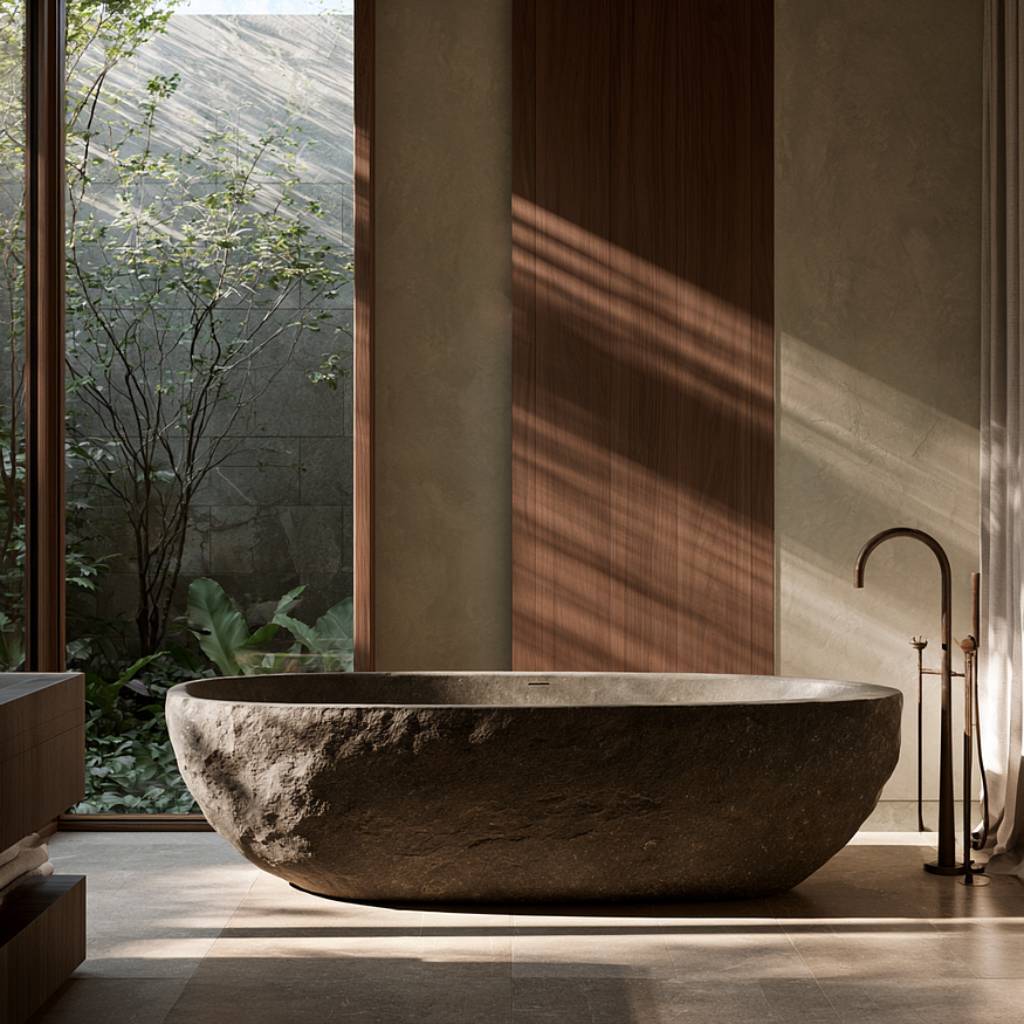
This creates an architectural opportunity. A bathroom can be designed as a sequence rather than a collection of expensive fixtures. The transition from bedroom to dressing area to bathing space can gradually change the mood. Daylight might arrive indirectly. A textured stone surface can meet bare feet differently from polished flooring. A deep bath might be positioned towards a garden, courtyard or distant skyline, making washing briefly inseparable from contemplation.
None of this requires theatrical scale.
Indeed, the most convincing bathrooms often depend upon restraint. Too many surfaces, patterns and decorative gestures can undermine the psychological calm that gives the room its power. Material hierarchy matters more than material quantity. One beautiful stone, carefully detailed timber, plaster resistant to moisture, softly finished metal and precisely controlled light can produce greater richness than a room assembled as a catalogue of expensive products.
Here, material intelligence becomes critical.
Bathrooms are unforgiving environments. Water exposes weak detailing. Humidity tests coatings and joinery. Poor stone selection becomes visible through staining or maintenance problems. Metal finishes are touched repeatedly. Drainage, falls, waterproofing and ventilation determine whether an elegant room remains elegant after years of use.
The philosophical bathroom therefore cannot be separated from technical knowledge. Serenity at the surface depends upon invisible discipline beneath it.
This is an important corrective to the romantic language surrounding contemporary wellness interiors. Calm is constructed. A bathroom feels effortless only when architects, designers, contractors, stone specialists, lighting consultants, plumbers, fabricators and manufacturers have resolved a considerable number of practical problems.
Privacy Has Become a Form of Luxury
The contemporary home contains fewer spaces in which complete withdrawal is socially acceptable.
Bedrooms remain private, but they are increasingly invaded by phones, televisions, work and notifications. Studies are associated with productivity. Living spaces are connected to others. The bathroom retains an unusual cultural permission: the door may be closed.
That simple act matters.
Privacy today is not merely the absence of other people. It is freedom from demand. For ten minutes, nothing may need to be answered, produced, documented or shared. The bathroom becomes valuable precisely because its rituals are repetitive and ordinary. Washing the face, standing beneath water, brushing hair or sitting beside a bath can return attention to the body rather than the screen.
Design can either protect this experience or disrupt it.
There is a growing temptation to introduce technology into every available domestic surface. Mirrors display information. controls become digital. Water, light, sound and temperature can all be automated. These technologies can improve accessibility, efficiency and comfort, but sophistication should not be confused with constant interaction.
The most intelligent bathroom technology may be the technology that disappears.
A perfectly heated floor does not require attention. Excellent ventilation works without announcement. Lighting can shift almost imperceptibly from functional brightness to evening softness. Water temperature can remain precise without turning bathing into another digital interface.
The room becomes more advanced by feeling less technological.
The New Interior of Self-Care
The rise of the bathroom also reflects a broader shift in what affluent consumers expect from the home. There is increasing interest in spaces associated with recovery rather than entertainment: saunas, steam rooms, cold immersion, treatment areas and highly considered bathing environments.
Yet the most interesting development is not the domestic replication of the spa.
Commercial spas are designed to create temporary escape. A private bathroom belongs to repetition. Its significance comes from returning to the same surfaces every morning and evening for years.
That makes longevity more important than novelty.
Natural stone that develops character, timber that can tolerate and record age, hardware that feels satisfying after thousands of uses and fittings designed to be maintained rather than discarded all become part of the room’s meaning. The bathroom is where claims about material quality encounter unusually demanding reality.
For brands, this offers fertile editorial territory. Bathroom manufacturers, stone companies, lighting specialists, hardware makers, textile houses and home-technology firms can contribute meaningfully when their work addresses ritual, touch, water, durability, maintenance and privacy rather than simply styling.
The strongest products in this space do not merely occupy the bathroom. They improve the way the body moves through it.
A handle is important because it is held. A basin matters because hands meet it repeatedly. The edge of a bath determines how someone enters and leaves. A towel carries softness against wet skin. Light affects the face encountered in the mirror.
These are intimate design decisions.
Perhaps that is why the bathroom has become such a revealing measure of contemporary domestic culture. The living room tells us how people wish to be received. The dining room tells us how they gather. The kitchen tells us how they organise nourishment and hospitality.
The bathroom reveals something quieter.
It tells us how people wish to experience themselves when nobody else is present.
Habitus Journal Editorial Note
Habitus Journal welcomes architects, interior designers, bathroom and wellness brands, natural-stone specialists, lighting companies, hardware makers and material studios to share projects, products and processes that explore privacy, bathing rituals, tactility, water and long-term material performance for possible editorial consideration.
Follow or subscribe to Habitus Journal for essays on architecture, culture, craftsmanship, materiality and the changing meaning of luxury.